Bridal Hair Accessories: Combs, Pins, Headbands, and Veils
Choose bridal hair accessories for your hairstyle and veil. Compare combs, pins, vines, and headbands, with buying tips and a hair-trial checklist.
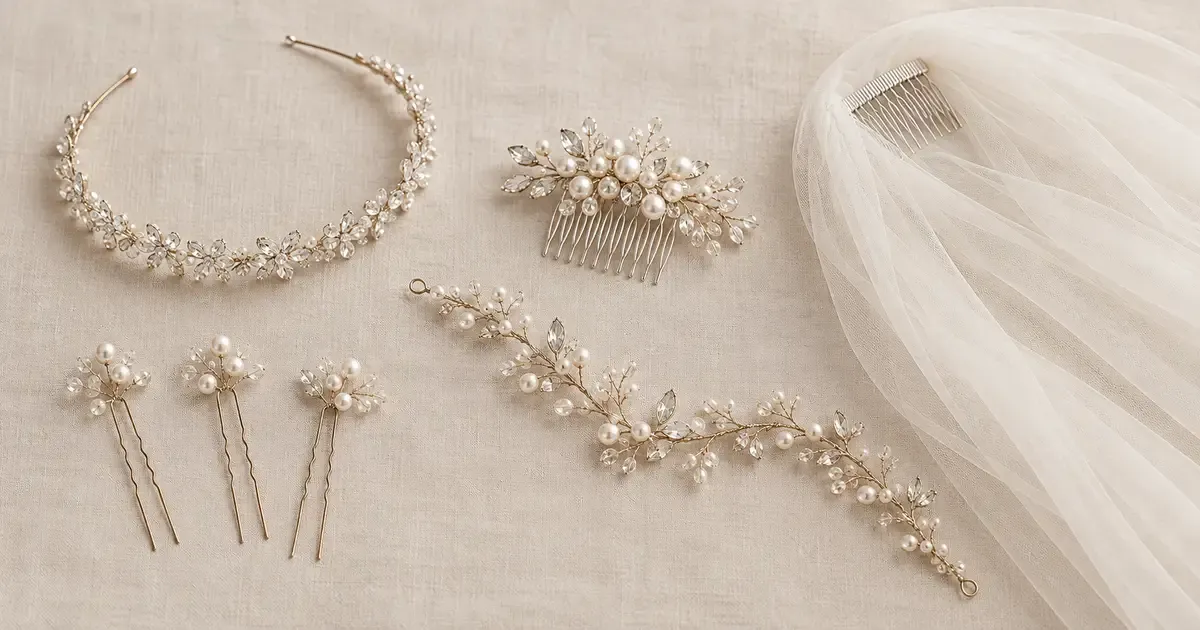
Bridal hair accessories should feel like part of your look, whether that means a few pearl pins or a sparkling headband. Start with your hairstyle, then choose a piece you enjoy wearing with your dress, jewelry, and veil. This guide compares accessory types and gives you a practical trial plan, with manufacturer-listed examples rather than firsthand product testing or comfort scores.
In this guide:
- Choose the Accessory Shape Before the Brand
- Match the Piece to Your Hair and Personal Style
- Plan Your Accessory and Veil Together
- Compare Specific Pieces Before Buying
- Use Your Hair Trial to Make the Final Decision
Choose the Accessory Shape Before the Brand
How Do You Choose a Bridal Hair Accessory?
Choose a bridal hair accessory around your intended hairstyle, preferred amount of detail, and comfort. Combs create a focal point, pins let you distribute smaller accents, vines follow the hairstyle, and headbands frame the face. Bring the actual piece and veil to your trial to assess placement, support, and removal.
Combs and Pins: One Accent or Several Small Details
A decorative comb gathers the detail in one place. It can sit beside a bun or add a focal point to a half-up style, depending on where your stylist can secure it. Look beyond the decoration to the comb itself: its width, curve, teeth, and weight affect how it fits into your hair.
Individual pins give you more freedom to distribute the detail. A few clustered above a chignon create a different effect from pins scattered through a braid. Start with fewer pieces at the trial, then add more if you want a stronger accent. There is no required number for a bridal look.
Neither option comes with a universal comfort guarantee. A small pin can still feel uncomfortable in the wrong position, and a larger comb may work well when the hairstyle supports it. Fit and placement matter more than an impressive-looking product photo.
Headbands, Vines, and Crowns
A headband frames the face and makes its detail visible from the front. That can be lovely if your dress has a simple neckline or you want the accessory to feature in portraits. Try the band for more than a quick glance in the mirror; the ends and contact points should feel comfortable.
A flexible vine can follow the curve of a bun, braid, or half-up style. Its length and attachment points determine how it can be arranged. Ask how much adjustment the manufacturer allows, because bending a piece repeatedly may damage delicate components. Plan removal carefully if branches or beads could catch loose strands.
Crowns and tiaras add height or a defined silhouette. They need not be reserved for a ballroom, but their scale should be something you love from the front, side, and back. A dramatic piece can be the main accessory without requiring equally bold earrings or a necklace.
| Accessory | Visual Effect | What to Explore at the Trial |
|---|---|---|
| Decorative comb | A concentrated accent beside or above a style | Base width, support, and scalp clearance |
| Individual pins | Scattered details or a small cluster | Placement, quantity, and removal |
| Headband | A frame around the face | End pressure, fit, and visibility |
| Flexible vine | A line of detail following the hair | Length, attachment points, and snagging |
| Crown or tiara | Height and a distinct silhouette | Balance, stability, and veil space |
Match the Piece to Your Hair and Personal Style
Fine Hair, Thick Hair, and Short Cuts
For fine or low-density hair, start by asking how the accessory will be supported. A delicate-looking piece may still have a heavy base, while several small pins may require more preparation than expected. Your stylist can help you compare a compact accent with a wider band using your actual hair.
Thick hair can provide room for different placements, but it does not automatically make every headpiece comfortable. Consider the finished hairstyle, including any extensions, rather than judging by hair volume alone. A wide comb might sit well in one bun and awkwardly against another.
Short hair does not rule out bridal accessories. A headband, small clip, or carefully positioned accent can create a finished look without an updo. Bring examples close to your own cut and texture. For longer styles, browse Elegant Bridal Updos: Timeless Hairstyles for Your Wedding Day before choosing a shape.
Coordinate Finishes Without Following Rigid Rules
Gold with ivory and silver with bright white are possible starting points, not requirements. Hold the accessory beside your earrings and a dress swatch in daylight. You may prefer a coordinated finish, a mixed-metal look, or an heirloom that matters more than an exact match.
Consider where the detail sits. An embellished neckline and statement earrings may leave you wanting a quiet hair accent; a simpler dress may invite a more prominent headpiece. Photograph the combination rather than judging each purchase separately. The goal is a look you recognize yourself in.
Pearls, crystals, and floral details can echo something in your gown or bouquet without matching literally. If the piece feels too formal during the trial, try a different position or fewer individual pins before deciding it is wrong for you.
Plan Your Accessory and Veil Together
Can You Wear a Bridal Hair Accessory With a Veil?
You can wear a bridal hair accessory with a veil when the hairstyle comfortably supports both attachments. Bring both pieces to your trial so your stylist can arrange them without crowding or hiding the detail you love. Practice removing the veil while leaving the hairstyle and decorative accessory in place.
A veil might sit above or below an updo depending on its design and the effect you want. Similarly, a decorative comb may sit beside the veil rather than directly above it. Take photos from the angles your guests and photographer will see. Our Best Wedding Veils for a Romantic Bridal Look guide can help you compare veil styles.
Rehearse the Reception Change
If you plan to remove the veil, practice that step before the wedding. Ask which pins belong to the veil and which support the hairstyle or accessory. A helper who understands the arrangement is less likely to undo the wrong attachment during a rushed change.
Try the hairstyle with the veil removed too. The remaining accessory should look intentional and still feel secure. If you want a second headpiece for the reception, include the swap in the trial rather than assuming it will be straightforward.
Compare Specific Pieces Before Buying
Three Manufacturer-Listed Examples
These examples show different design approaches, not a ranked shortlist or a promise of all-day comfort. Manufacturer pages were checked on October 20, 2026. Use the exact product listing for current dimensions, materials, availability, pricing, and purchase conditions.
| Identifiable Piece | Why Compare It | What Still Needs a Personal Check |
|---|---|---|
| Jennifer Behr Arielle Headband | A named crystal headband to assess for a prominent front-facing accent | Fit, scale, contact points, and current sale conditions |
| Twigs & Honey Baby’s Breath Pearl and Crystal Pin Set, Style #2114 | A two-pin design described with freshwater pearls and opal crystals | Whether two pins create the effect you want and how they attach |
| Olivia The Wolf Dakota Headpiece | A design offering ribbon ties and side loops for different placements | Which wearing method suits your hairstyle and selected finish |
Should You Buy Your Hair Accessory Before the Trial?
Have your bridal hair accessory available for the trial so your stylist can assess the actual piece with your hairstyle and veil. Before buying, compare delivery and production times with the appointment date, and read the return conditions. If you are undecided, ask whether your stylist has samples to try.
Ask for missing information that would affect your decision, such as dimensions, weight, attachment photographs, or care instructions. You do not need a designer label for a beautiful result, but you do need a clear idea of what will arrive. Avoid choosing several alternatives on the assumption that every piece can be returned.
Use Your Hair Trial to Make the Final Decision
How Do You Test a Bridal Hair Accessory at Your Trial?
Wear the actual piece while your stylist assesses the finished look. Turn your head, look down, and move gently as you might during the ceremony. Describe pressure or pulling where you feel it; an adjustment is more useful than trying to tolerate discomfort. A successful trial helps you choose, although it cannot guarantee an entire day’s wear.
- Look from every angle: Take front, side, and back photographs.
- Notice contact points: Identify pressing ends, comb teeth, or tight attachments.
- Try gentle movement: See whether the piece shifts or catches loose hair.
- Add the veil: Assess both appearance and attachment space.
- Practice removal: Learn the order for removing the veil and accessory.
- Record the plan: Photograph placement and note the pins or supplies needed.
Keep the Wedding-Day Plan Simple
Follow the preparation routine agreed with your stylist rather than adding unfamiliar texture products at the last minute. Backcombing or extra pins may help a particular style, but they are not mandatory for every hair type and accessory. Bring the exact piece, its packaging, and any manufacturer instructions to the appointment.
Pack the supplies your stylist recommends and nominate someone who knows how to help. Use Wedding Day Emergency Hair Kit: Essentials and Quick Fixes for a practical starting point. After the celebration, remove attachments gently and store the headpiece according to its care instructions.
Choose the accessory you enjoy seeing in the mirror and feel comfortable wearing. A few well-placed pins can feel just as bridal as a crown. Once the hairstyle, veil, and headpiece work together, you can stop comparing and look forward to wearing them.
Frequently Asked Questions
What bridal hair accessory should I choose?
Start with your intended hairstyle and how much decoration you want visible. Pins offer flexible placement, combs create a concentrated accent, vines follow a hairstyle's shape, and headbands frame the face. Test the actual piece for comfort, attachment, and veil compatibility before deciding.
Should I buy my hair accessory before my hair trial?
Bring the actual accessory to your trial when possible so your stylist can assess its weight, attachment, and placement with your veil. Before buying, check the delivery date and return conditions. If you are undecided, ask whether your stylist has samples you can try first.
Can I wear a hair accessory with a veil?
Yes, if the hairstyle supports both pieces comfortably. Plan the decorative accessory and veil attachment together, then practice removing the veil without disturbing the accessory. Placement depends on the actual combs, hairstyle, and headpiece rather than one fixed rule.
How do I stop a bridal hair accessory slipping?
Ask your stylist to choose an attachment method suited to the piece and your hairstyle. That may involve discreet pins, built-in loops, or a prepared section of hair. Test gentle movement during your trial and ask for adjustments if the piece shifts, pulls, or presses against your scalp.

Bridal by Bentley
Wedding Editorial
Bridal by Bentley publishes wedding inspiration and practical planning guides to help couples compare options and prepare for their celebrations.