Wedding Veils: Lengths, Fabrics, and Placement
Choose a wedding veil with advice on length, fabric, placement, and your dress train. Plan measurements, your hair trial, veil removal, and storage.
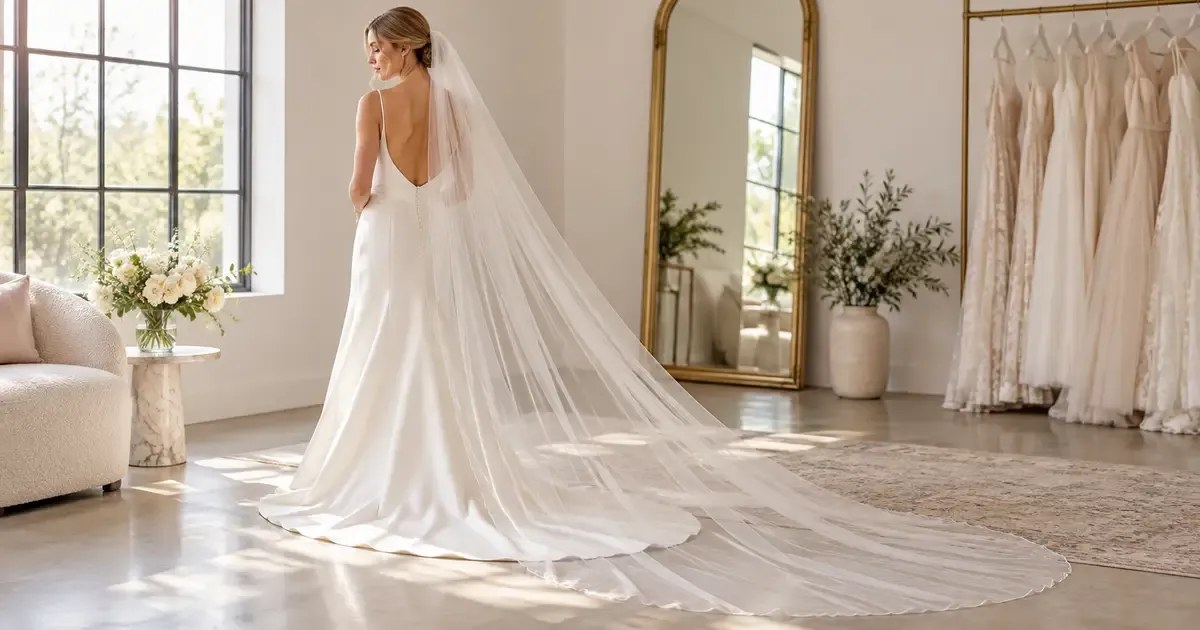
Wedding veils change a bridal look through their length, transparency, and the way they fall from the hair. A simple sheer layer can reveal the back of your gown, while lace or gathered tiers add another line of detail. Start with the effect you love, then use your actual dress, shoes, and hairstyle to work out the measurements and attachment.
In this guide:
- Separate Veil Length From Style
- Measure With Your Dress and Attachment Point
- Compare Fabric, Width, and Edge Details
- Use Your Hair Trial to Plan Placement and Removal
- Order, Transport, and Care for the Actual Veil
Separate Veil Length From Style
Length Names Help You Browse
Birdcage, fingertip, walking or waltz, chapel, and cathedral are useful search terms, but the maker’s measurements should guide the purchase. A fingertip veil may fall differently on two people, and changing its attachment position changes where the edge lands. Ask for the length in inches and how it is measured.
The David’s Bridal veil guide introduces different lengths and effects. Use the names to narrow your options, then compare the actual veil with your outfit. You do not need a cathedral venue for a long veil or a civil ceremony for a short one.
| Browsing Term | Effect to Explore | What to Verify |
|---|---|---|
| Birdcage | Netting close to the face | Coverage, attachment, and where the edge rests |
| Fingertip | A shorter layer around the lower body | Actual drop from your attachment point |
| Walking or waltz | A longer silhouette that may clear the floor | Where it falls on you with shoes on |
| Chapel | A trailing layer behind the dress | Product length and relationship to the gown |
| Cathedral | A more extended trail | Exact length, width, and handling requirements |
Mantilla, Juliet Cap, and Blusher Describe Other Choices
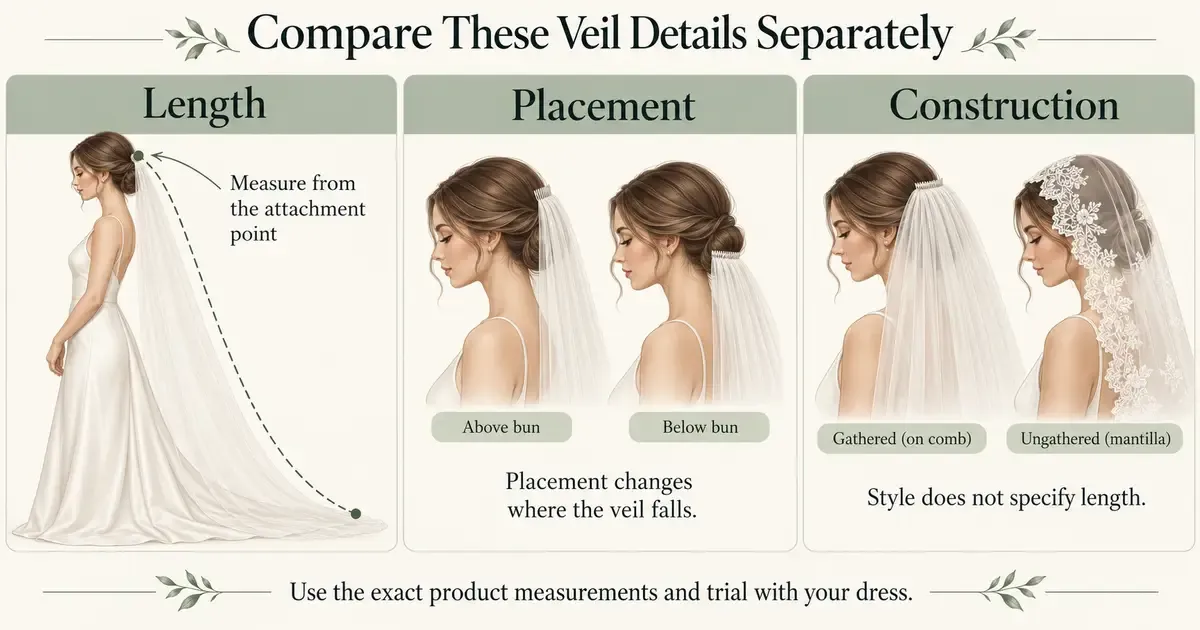
A mantilla is associated with lace framing the face and a relatively flat drape. It is not a fixed measurement. For example, David’s Bridal identifies a cathedral mantilla lace-edge veil, style VM1468, combining a construction style with a length label.
A Juliet cap creates a cap-like shape around the head, while a blusher is the section intended to fall over the face. Either affects the overall design independently of the rear length. Ask whether a two-tier description includes a blusher and whether the stated length refers to the longest tier or another measurement.
Measure With Your Dress and Attachment Point
How Do You Measure for a Wedding Veil?
Measure for a wedding veil from the intended attachment point toward the edge position you want, wearing your dress and wedding shoes. Ask how the maker measures the specific design and any blusher. Compare exact length and width rather than relying only on names such as fingertip, chapel, or cathedral.
Start Where the Veil Will Be Worn
Try the dress with your planned shoes and undergarments, following your boutique’s fitting advice. Identify the likely attachment position with your stylist, then have someone help measure toward your preferred edge. A higher or lower attachment can change the result even when the veil itself is unchanged.
For a trailing veil, follow the intended drape rather than pulling a tape straight through the air. This gives you a starting estimate, not a substitute for the maker’s measuring instructions. Record the position and measurement so you can explain what you want when ordering.
Does Your Veil Have to Be Longer Than Your Dress Train?
Your veil does not have to be longer than your dress train. A longer veil creates another trailing layer, while a shorter one can reveal gown details. Compare the edges with your actual dress, shoes, and attachment position, then photograph the back and side views to choose the outline you enjoy.
Pay attention to the gown’s focal details. A veil edge may cross back buttons or embroidery when you stand, then move when you sit. That is something to assess, not automatically reject. How to Choose a Wedding Dress: Styles, Budget and Fittings can help you coordinate the fitting decisions.
Include the Route and Reception Plan
Think about steps, a narrow aisle, lawn paths, doorways, and the place where portraits will happen. A longer veil may need someone to arrange it or help carry it between locations. Ask the venue and photographer where there is room to spread it without blocking guests.
If you want to remove it before dinner or dancing, plan that change. You can also keep a shorter veil on if it works with your movements. No length alone guarantees you will avoid stepping on fabric or catching it against furniture.
Compare Fabric, Width, and Edge Details
Ask for Composition and a Swatch
Tulle and net descriptions can cover different fibers and finishes. Do not infer a universal composition from a name such as English net or assume every silk tulle drapes identically. Ask for the actual fiber content, width, care instructions, and a sample if available.
Compare the sample beside your dress in daylight and indoor light. Look at transparency over beadwork and how the fabric falls when gathered. White, ivory, and other shade names are not standardized across every seller, so a familiar label does not guarantee an exact match.
Look at Gathering as Well as Length
Two veils of the same length can look quite different if one is wider or more heavily gathered. More fabric around the attachment can create volume; a less gathered design may show more of the hairstyle and dress. Ask for worn views from the front, side, and back.
Lace, pearls, appliqué, and other details can affect the edge and overall feel. You do not have to avoid lace over a lace gown. Try the combination and decide whether you enjoy the repeated pattern or prefer a quieter layer.
| Detail | Look to Explore | Practical Question |
|---|---|---|
| Plain cut edge | A less defined outline | How does the edge look against your gown? |
| Stitched or pencil edge | A fine visible perimeter | What thread and finish are used? |
| Lace or appliqué border | A decorative frame | Where do the motifs sit on your body and train? |
| Horsehair-style trim | A more structured edge | How does it move and pack? |
| Scattered embellishment | Detail across the veil | How does it affect visibility, handling, and care? |
Use Your Hair Trial to Plan Placement and Removal
Bring the Actual Veil and Headpiece
The attachment should suit your veil and hairstyle together. A comb above a bun, below an updo, or near the crown changes the outline. Let your stylist try the intended pieces instead of choosing one location because it is described as universally secure.
Hair worn down can support a veil in an appropriate arrangement, but the method depends on your hair and the piece. Your stylist may use discreet pins or prepare a section of hair. Neither a particular comb material nor a crossed-pin pattern guarantees every veil will stay put.
For hairstyle ideas, see Elegant Bridal Updos: Timeless Hairstyles for Your Wedding Day. Bridal Hair Accessories: Combs, Pins, Headbands, and Veils covers the decorative pieces that may share the same attachment area.
How Do You Test a Veil at Your Hair Trial?
- Bring the actual veil and any decorative headpiece.
- Ask your stylist to assess the attachment in your chosen hairstyle.
- Photograph the front, side, and back to judge the drape.
- Walk, sit, and turn gently, noticing pulling or shifting.
- Add your jewelry to assess where the fabric makes contact.
- Practice removal with your helper and agree on a wind backup.
Practice Movement and the Veil Change
Turn, sit, and walk gently during the trial, noticing pulling or shifting. Add your earrings and any necklace to see where fabric makes contact. Ask for an adjustment if the arrangement feels uncomfortable rather than assuming you must tolerate it for photographs.
Have your helper practice removal with your stylist’s guidance. Identify which attachments belong to the veil and which support the hairstyle. Agree on what to do if wind becomes a problem; a planned removal or sheltered location is preferable to improvising extra pins while the fabric pulls.
Order, Transport, and Care for the Actual Veil
Compare the Complete Order
Record the style, dimensions, shade, attachment, tiers, and selected edge on your order. Ask about production and delivery times, especially for custom measurements. Read item-specific return conditions before approving changes rather than relying on a store-wide promise.
Online marketplaces include different sellers and materials. Customer photographs can help with appearance, but they do not establish fiber content or guarantee a color match. A physical sample and clear written description are more useful when the fabric choice matters to you.
Follow the Maker’s Preparation Instructions
Ask how the veil should be unpacked, hung, transported, and stored. Long veils, delicate lace, and embellished edges may need different support. Keep the supplied packaging or arrange suitable protective storage rather than assuming every piece should hang by its comb.
Before using a steamer, iron, or any heat, read the instructions for that exact veil. There is no universal distance or temperature appropriate for all fabrics and decorations. If guidance is missing, contact the maker or boutique and ask whether they can prepare it professionally.
Once the length, placement, and removal plan feel right, you can enjoy the veil as part of the look rather than another task to manage. A simple layer and an elaborate lace border can both feel romantic; the better choice is the one you love with your own dress.
Frequently Asked Questions
Does my veil have to be longer than my dress train?
No. Extending the veil beyond the train is one styling option, not a requirement. Compare the edges with your actual dress, shoes, and planned attachment position. A shorter veil can leave the train visible, while a longer one creates another trailing layer. Choose the outline you enjoy.
How do I measure for a wedding veil?
Start at the intended attachment point and measure toward the edge position you want while wearing your dress and wedding shoes. Ask how the maker measures its product, including any blusher. Compare exact length and width rather than relying only on labels such as fingertip or cathedral.
Is a mantilla veil a particular length?
No. Mantilla describes a lace-framed draping style rather than a fixed length. A mantilla can also be sold as fingertip, chapel, or cathedral length. Check its actual dimensions and attachment design rather than treating the style name as a measurement.
Can I wear a veil with my hair down?
Yes, if the actual veil can be supported comfortably in your chosen hairstyle. Bring it to your trial so the stylist can select a suitable attachment and assess movement. No comb material or pin arrangement guarantees that every veil will stay in place.
Can I steam my wedding veil?
Follow the maker's instructions for the specific fabric, lace, and embellishments before using steam or heat. Ask the boutique or maker if those instructions are missing. A universal steaming distance or temperature is not suitable for every veil, and professional preparation may be preferable.

Bridal by Bentley
Wedding Editorial
Bridal by Bentley publishes wedding inspiration and practical planning guides to help couples compare options and prepare for their celebrations.