Statement Bridal Necklaces: Necklines, Fit, and Styling
Choose a statement bridal necklace that works with your dress. Compare shapes, placement, veil compatibility, comfort, and practical buying checks.
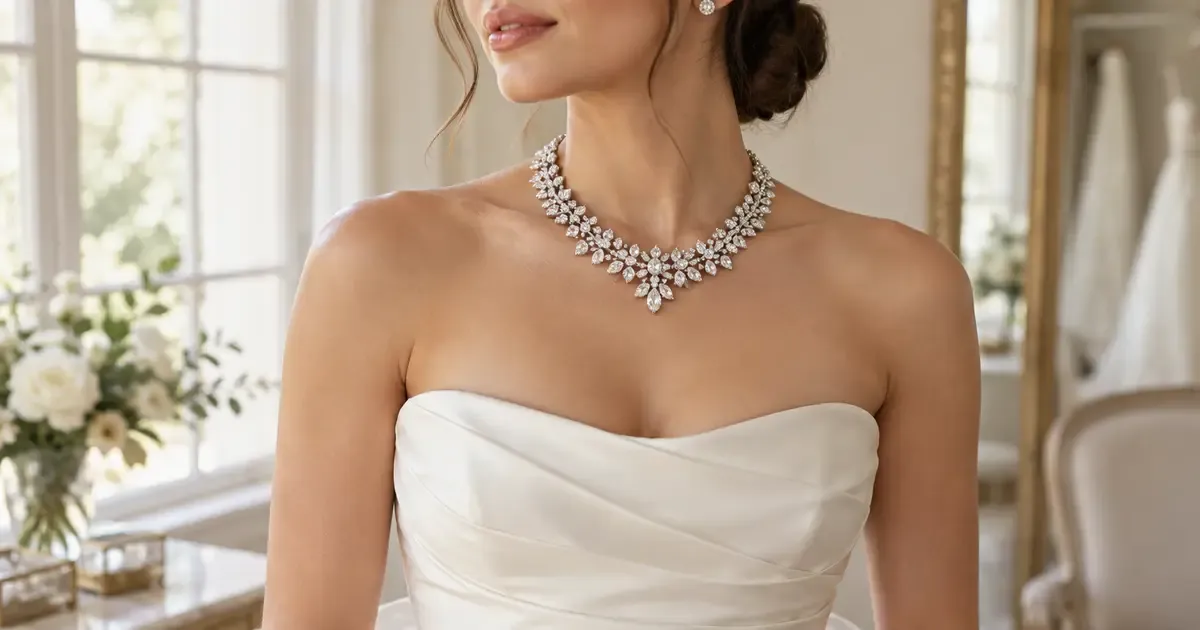
A statement bridal necklace can give a simple gown a striking focal point or add a personal detail to an open back. The key is finding a shape that sits where you want it and feels comfortable as you move. This guide compares styles, shows placement ideas, and helps you assess the actual piece with your dress, using sourced examples rather than firsthand product reviews.
In this guide:
- Choose Your Necklace Shape
- Find the Right Position Against Your Dress
- Balance Earrings, Hair Accessories, and Your Veil
- Compare Identifiable Pieces Before Buying
- Rehearse Comfort, Movement, and Removal
Choose Your Necklace Shape
Collars, Bibs, and Pearl Strands
A collar creates a relatively short line of detail around the neck, while a bib extends into a broader decorative area. Both can make a strong impression above an open bodice. Look at the full dimensions: two necklaces with the same chain length can cover very different amounts of skin.
A pearl strand can also be a statement piece, especially with larger pearls or several rows. It offers a different visual texture from a crystal collar. Think about whether you want a continuous line, a broad spread, or a central focal point before choosing a brand.
The terms “collar,” “choker,” and “bib” are useful browsing descriptions, but sellers may use them differently. Measurements and photographs of the actual piece are more useful than the category name alone. Ask for a worn image or dimensions if the listing leaves its scale unclear.
What Is a Backdrop Necklace?
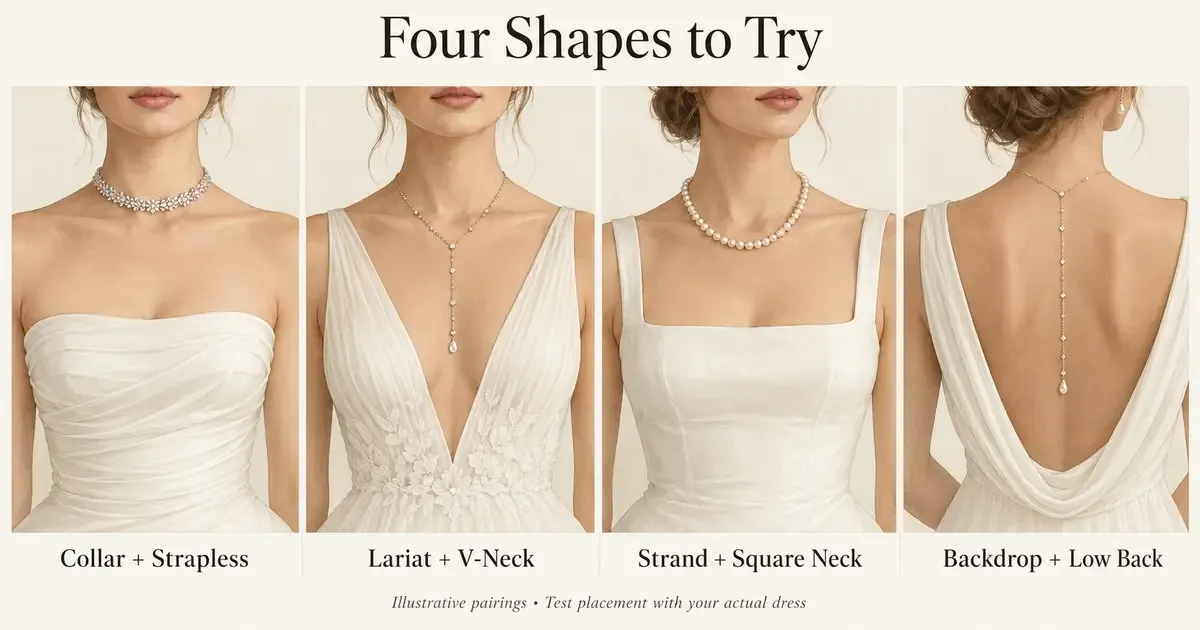
A backdrop necklace has a decorative chain or detail that falls down the back, often within a low-back gown’s opening. Some designs include a front necklace, while others attach differently. Compare the actual drop and attachment with your dress, hairstyle, and veil, then assess how it moves when you sit.
Pendants and Lariats
A pendant concentrates detail at the front. A lariat or Y-shaped necklace adds a vertical line, which you might enjoy within an open V-neck. Notice where the lowest point falls when you sit or lean rather than judging it only while standing still.
A backdrop necklace places decorative detail down the back. Some are part of a conventional front necklace; others use a different attachment arrangement. Before buying, find out how the specific design is worn and whether the front and back lengths can be adjusted independently.
| Shape | Effect to Explore | Important Measurement |
|---|---|---|
| Collar or choker | A short line framing the neck | Wearing length and decorative depth |
| Bib | A broad front focal point | Overall width, depth, and chain length |
| Pearl strand | A continuous line of luster | Length, pearl size, and number of rows |
| Pendant or lariat | A central or vertical accent | Chain length plus the hanging drop |
| Backdrop | Detail within an open back | Front fit, back drop, and attachment position |
Find the Right Position Against Your Dress
What Neckline Works With a Statement Bridal Necklace?
Open necklines such as strapless, sweetheart, square, and V-neck gowns give you space to try a statement bridal necklace. Compare the necklace’s shape with the exposed area and bodice details, then sit and turn in the actual outfit. Choose the combination you enjoy rather than following a fixed spacing rule.
Use the Neckline as a Starting Point
A strapless or sweetheart gown leaves room to try a collar, bib, or strand. A square neckline gives you another shape to compare with rounded or angular jewelry. For a plunging V, try a pendant or lariat alongside the simpler option of no necklace at all.
These are styling possibilities rather than requirements. With a high neckline, you might prefer earrings, but you can also explore a necklace over the fabric if the look and contact suit the gown. Beading, lace, and appliqué deserve a careful fitting rather than an automatic yes or no.
Measure the Space You Actually Want to Fill
Try the dress with the undergarments and alterations planned for the wedding. They can affect where the bodice sits. Identify where you would like the necklace’s lowest point to fall, then compare that position with the listing’s chain length and decorative drop.
There is no universal two-inch gap that works for every bride. A short chain can sit differently on different bodies, and an extender may shift the whole design rather than simply lowering one point. If you are measuring without the necklace, use a soft tape or plain cord as a rough guide, not a guarantee of fit.
Sit, turn, and lean gently during the fitting. Watch whether the necklace slips behind the bodice, rests against embroidery, or moves into a position you dislike. A small length adjustment may help, but ask the retailer or jeweler whether that specific design can be altered.
Balance Earrings, Hair Accessories, and Your Veil
Choose the Amount of Detail You Enjoy
Small studs are an easy starting point when you want the necklace to lead the look. They are not mandatory. Larger earrings and a bold necklace can be a deliberate choice if you love the combination; take a photograph to assess the whole portrait rather than comparing pieces in separate boxes.
The same applies to your headpiece. A quiet comb may let a crystal collar stand out, while an elaborate crown creates a more layered effect. Try both if you are undecided. Bridal Hair Accessories: Combs, Pins, Headbands, and Veils explains the different attachment and shape options.
Can You Wear a Statement Necklace With a Veil?
You can wear a statement necklace with a veil if the actual pieces work comfortably together. Bring both to a fitting and assess contact as you sit, turn, and remove the veil. Its length or edge alone cannot guarantee compatibility; ask a jeweler to inspect any rough settings or unreliable closures.
For a backdrop design, look from behind with the veil on and off. You might be happy for the necklace to appear mainly at the reception, or you may want it visible during the ceremony. Practice removing the veil with a helper who knows which attachments belong to which piece. Compare options in Best Wedding Veils for a Romantic Bridal Look.
Compare Identifiable Pieces Before Buying
Two Sourced Examples of Different Shapes
The following manufacturer-listed examples illustrate a front-facing crystal design and a pearl backdrop. They are not wear-tested recommendations. Listings were checked on October 20, 2026; use the selected product variant for current dimensions, materials, price, and availability.
| Exact Example | Manufacturer-Listed Detail | What to Assess Yourself |
|---|---|---|
| Swarovski Una Angelic Necklace, Article 5727095 | Round-cut crystals, rhodium plating, a foldover clasp, and an extender | Whether its listed wearing range and decorative width suit your neckline |
| Treasures by Agnes Alexandria Backdrop Necklace | A gold-chain design described with genuine freshwater pearls | The selected drop length, front arrangement, and care instructions |
Buy for Fit, Not Just the Styled Photograph
Record the reference or style name, selected finish, dimensions, and any extension options before ordering. Ask about missing details such as weight, reverse-side construction, or clasp photographs. A necklace does not need a luxury label to create a striking look, but the seller should describe what you are buying clearly.
For broader material questions, the FTC’s jewelry guidance explains accurate descriptions of metals, gemstones, cultured pearls, and imitations. Crystal, cultured pearl, and mother-of-pearl descriptions are not interchangeable. Our Luxury Bridal Jewelry: Materials, Styling, and Buying Advice covers the wider purchasing decisions.
Read item-specific delivery and return terms, especially before approving a custom length. Ask whether alterations or personalization affect eligibility. Work backward from a fitting where you can wear the actual piece rather than relying on a universal ordering deadline.
Rehearse Comfort, Movement, and Removal
How Do You Test a Bridal Necklace With Your Dress?
- Put on the dress with its planned undergarments.
- Position the necklace and photograph its front and back fit.
- Sit, turn, and lift your arms gently to assess movement.
- Add your earrings, headpiece, and veil to see the full look.
- Practice the closure and any veil-removal steps.
- Ask a jeweler about rough settings, fit adjustments, or fastening concerns.
Notice How the Piece Feels
Wear the necklace long enough to notice pressure, pulling, or an awkward contact point. Neither a hollow setting nor a wide chain guarantees comfort. If you know certain materials irritate your skin, ask about the components that touch it rather than choosing by price or appearance alone.
Move as you expect to during the celebration: sit at a table, turn to speak to someone, and lift your arms gently. A backdrop chain may shift against a chair, while a front pendant may move toward the gown. These observations help you decide whether a different length or shape would suit you better.
Check Closures Without Assuming One Design Is Best
Have the retailer demonstrate the actual closure. Foldover clasps, lobster clasps, and other fastenings work differently, and not every necklace needs an extender or double lock. Make sure you or your helper can operate it confidently.
If a setting feels rough, catches unexpectedly, or seems loose, ask a qualified jeweler to inspect it before wearing it with delicate fabric. Do not drag jewelry across your gown or assume a ribbon test proves it cannot snag. Follow the manufacturer’s care instructions and keep the packaging for storage after the wedding.
Choose the necklace that gives you the effect you love without demanding constant adjustment. Once its position, movement, and accessories work together, you can enjoy the statement rather than managing it all evening.
Frequently Asked Questions
What neckline works with a statement bridal necklace?
Strapless, sweetheart, square, and open V-neck gowns give you different spaces to explore. Try the actual necklace with the dress, then sit and turn to see where it moves. The right pairing depends on necklace shape, bodice details, and your preferences rather than one required gap above the fabric.
What is a backdrop necklace?
A backdrop necklace has a decorative chain or detail that falls down the back. Some designs include a front necklace and others attach differently. Compare its drop with the dress's back opening, and test it with your hairstyle and veil so the detail remains visible and comfortable.
Can I wear earrings with a statement bridal necklace?
Yes. Small studs are an easy starting point if you want the necklace to stand out, but larger earrings are an option too. Try the complete look and photograph it from different angles. Choose the amount of detail you enjoy rather than treating one focal piece as a strict rule.
Can I wear a statement necklace with a veil?
Yes, depending on how the actual pieces interact. Bring the necklace and veil to a fitting, and gently assess contact as you sit, turn, and remove the veil. No particular veil length or edge guarantees compatibility. Ask a jeweler to inspect rough settings or unreliable closures.

Bridal by Bentley
Wedding Editorial
Bridal by Bentley publishes wedding inspiration and practical planning guides to help couples compare options and prepare for their celebrations.