Budget Wedding Earrings: Styles, Materials, and Comfortable Fit
Find budget wedding earrings that suit your style. Compare shapes, materials, fit, and buying checks, with advice for your hairstyle, neckline, and veil.
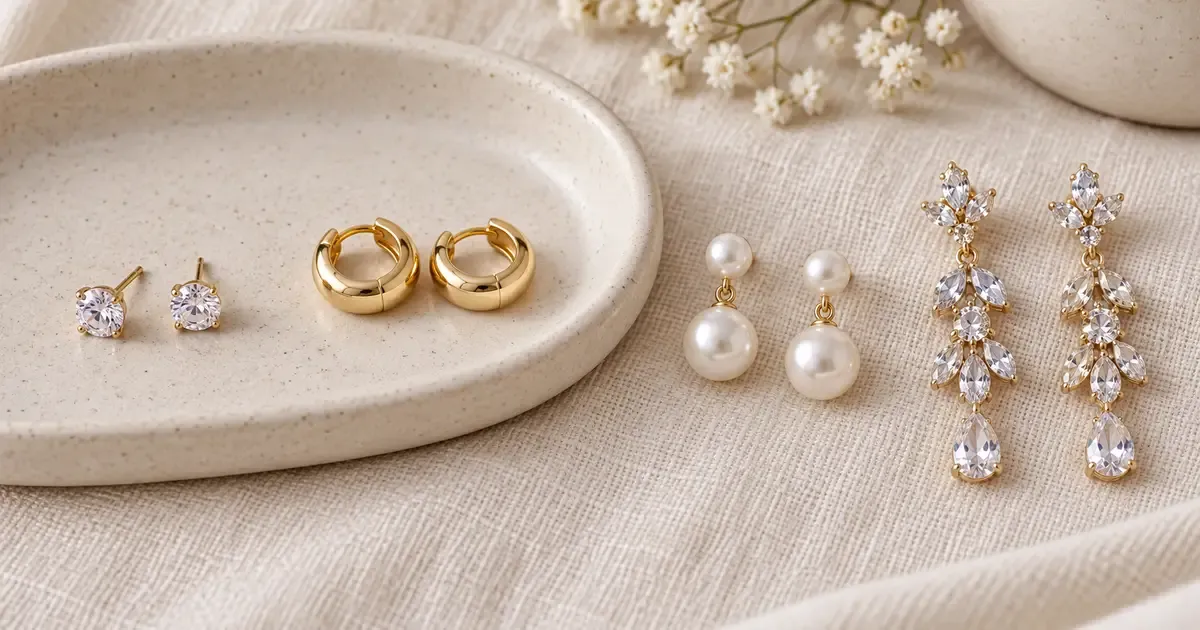
Budget wedding earrings can feel special without taking a large share of your wedding spending. Start with a shape you love, then look closely at the materials, dimensions, and fit of the actual pair. This guide compares styles and practical buying checks, with a manufacturer-listed example rather than wear-tested rankings or promises of all-day comfort.
In this guide:
- Choose the Earring Shape You Want to Wear
- Understand Materials and Personal Sensitivities
- Build a Budget Around the Complete Purchase
- Try Earrings With Your Hair, Dress, and Veil
- Plan Delivery, Care, and Wedding-Day Storage
Choose the Earring Shape You Want to Wear
How Do You Choose Budget Wedding Earrings?
Choose budget wedding earrings by comparing the shape you enjoy with the actual materials, dimensions, fastenings, and complete price. Try the pair with your hairstyle, dress, and veil before deciding. A lower price need not rule out a lovely look, but no price or material label guarantees comfort for every wearer.
Studs and Huggies for Detail Close to the Face
Studs keep the decoration near the lobe. They can work well when a neckline, necklace, or headpiece already provides plenty of detail, but they are also a complete choice on their own. Look at stone diameter and setting depth; a small front view does not tell you how far the earring projects.
Huggies sit close around the lobe, while larger hoops create a more visible outline. The inside diameter matters as much as the outside measurement. A compact hoop that suits one piercing position may feel cramped on another person, so avoid choosing by the word “small” alone.
Neither style automatically prevents catching or pressure. A stud back can press when you turn your head, and a hoop may brush hair or fabric. The useful question is how the pair works on you, not whether its style is usually described as comfortable.
Pearl Drops and Chandeliers for Movement
Pearl-style drops create a softer line below the ear. Read whether the listing describes cultured pearls, imitation pearls, or another material; appearance alone cannot establish this. A short drop can be restrained, while several larger elements create a more prominent look.
Chandeliers add length, width, and movement. They can be lovely against an open neckline or visible beneath loose hair, but check where the lowest point falls when you turn. You might prefer a shorter version if a longer pair brushes your shoulders or the bodice.
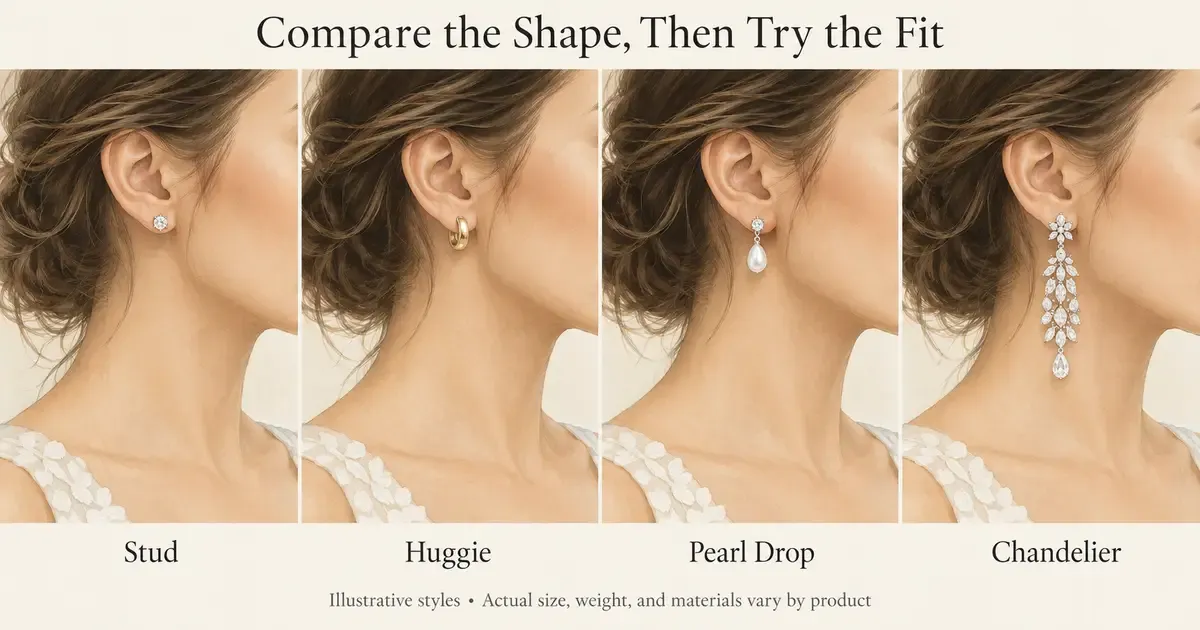
| Style | Effect to Explore | Fit Detail to Check |
|---|---|---|
| Stud | A compact accent near the face | Setting depth, post length, and back pressure |
| Huggie | A small outline around the lobe | Inside diameter and hinge clearance |
| Larger hoop | A more visible curved shape | Diameter, movement, and closure |
| Pearl drop | A soft hanging accent | Total drop, attachment, and component description |
| Chandelier | A wider or longer statement | Length, width, movement, and contact with shoulders |
Understand Materials and Personal Sensitivities
Separate the Post, Back, and Decorative Body
An earring can have a sterling-silver post and a differently composed decorative body. Gold plating is also a surface description, not proof that the whole piece is solid gold. Ask about the parts that touch your skin rather than treating one material label as a description of everything.
The FTC’s precious-metal buying guidance explains markings and terms used for gold, platinum, and silver. Use it to compare descriptions such as sterling silver, gold-plated, and vermeil. If a seller’s wording is unclear, request clarification before ordering.
Treat Stone Descriptions as Information, Not a Ranking
Cubic zirconia can be an appealing choice for sparkle, but it is not diamond. GIA identifies cubic zirconia as a diamond simulant. A photograph cannot reliably establish material identity, and there is no basis for promising that all budget stones will look identical to diamonds in wedding pictures.
Likewise, a seller’s “AAAAA” description should not replace clear information about stone identity, dimensions, and construction. Choose the look you enjoy at a price you are happy to pay. You do not need to present an imitation stone as something else for it to feel bridal.
Let Known Sensitivities Guide Your Questions
If you have worn a familiar pair comfortably, its documented materials can give you a useful starting point. Ask about posts, backs, and any hanging parts that touch your neck. Price, a precious-metal name, or a “hypoallergenic” label does not guarantee that a new pair will suit every wearer.
The American Academy of Dermatology’s contact-dermatitis advice emphasizes identifying and avoiding personal triggers. Recurring itching, swelling, or irritation deserves professional advice. Do not rely on a post coating or a brief home trial to establish allergy safety, and do not keep wearing a pair through discomfort to complete a test.
Build a Budget Around the Complete Purchase
How Much Should You Spend on Wedding Earrings?
Spend an amount on wedding earrings that fits your accessory budget, including delivery, applicable tax, and any backup you genuinely need. There is no required bridal minimum. Compare the exact pair rather than its price alone, and read return conditions before buying several alternatives that could tie up your budget.
If $50 is your complete limit, for example, a $45 pair may leave little room for shipping and tax. That is a planning example, not a statement about current prices. Compare the checkout total before deciding a listing fits your budget.
For the rest of your accessories, see Luxury Bridal Jewelry: Materials, Styling, and Buying Advice. One affordable pair can sit happily beside an heirloom or a more expensive necklace; everything does not need to come from the same retailer.
A Manufacturer-Listed Example to Compare
PAVOI Pavé Hoops were listed at $16.95 when checked on October 20, 2026, before any applicable tax or delivery charges. The manufacturer describes sterling-silver posts, gold plating, cubic zirconia, and 20 mm or 30 mm diameter options. Recheck the selected variant and checkout total because availability and prices can change.
This is a sourced example, not a tested recommendation or a guarantee for sensitive ears. Compare its measurements and component descriptions with your needs. The manufacturer’s product claims do not replace your own fitting or advice about known allergies.
| Purchase Detail | Ask or Check | Why It Matters |
|---|---|---|
| Dimensions | Total length, width, and inside hoop diameter | Product photos can obscure scale |
| Weight | Whether a stated weight covers one earring or the pair | Similar silhouettes can feel different |
| Materials | Posts, backs, body, plating, and stones | One component does not describe the whole piece |
| Fastening | How it opens, closes, and sits | You need to operate it comfortably |
| Returns | Item-specific eligibility and condition requirements | Earrings and personalized items may have restrictions |
| Total cost | Price, tax, delivery, and any extras | The listing price may not be the final bill |
Try Earrings With Your Hair, Dress, and Veil
Compare Visibility Rather Than Correcting Your Face
You do not need to balance or disguise a particular face shape. Try the shape that interests you, then see how it looks with your intended hairstyle. A compact pair may disappear beneath loose waves, while longer drops might be exactly the detail you want visible.
Photograph the front and side views in daylight and indoors. If you want to compare accessories together, Statement Bridal Necklaces: Necklines, Fit, and Styling offers ways to judge the complete look. Small earrings are one option with a bold necklace, not a requirement.
How Do You Test Wedding Earrings With Your Outfit?
- Read the return conditions before trying or wearing a new pair.
- Put the earrings on with your intended hairstyle and dress.
- Photograph the front and side views to assess visibility.
- Sit and turn gently, noticing pressure or contact with fabric.
- Add the veil and practice its removal with your helper.
- Stop wearing earrings that cause discomfort and seek advice for recurring irritation.
Make the Fitting Practical
Bring the actual pair to a hair trial or outfit fitting when possible. Sit, turn, and move gently, noticing contact with straps, shoulders, and veil fabric. Check whether the backs feel awkward and whether the earrings pull or shift. A successful fitting helps you decide, but cannot guarantee a full day’s comfort or prove that a piece will never catch.
Practice the veil change too. Ask your helper how to remove it without pulling jewelry or disturbing your hairstyle. Bridal Hair Accessories: Combs, Pins, Headbands, and Veils can help you plan the pieces together.
Plan Delivery, Care, and Wedding-Day Storage
Leave Time to Make Another Choice
Work backward from the appointment where you need the earrings, using the seller’s production and delivery estimates. Read return terms before wearing or altering anything, and inspect the delivery promptly for missing backs, damage, or a different variant. Do not assume a store-wide banner covers every item.
Keep a familiar backup pair if that makes you feel more relaxed. It can be something you already own rather than another wedding purchase. Choose someone who knows where the box is so a change does not become a search through overnight bags.
Follow the Care Instructions for the Actual Pair
Use the manufacturer’s cleaning and storage advice, particularly for mixed materials and plated finishes. Avoid assuming one cloth, chemical cleaner, or airtight bag is appropriate for every piece. Ask the seller about cosmetics and fragrance if the instructions do not explain them.
Put packaging and spare components somewhere secure after getting ready. Once you have chosen a pair that suits your look and feels right in the fitting, there is no need to keep chasing a more expensive bridal label. Your earrings can simply be a detail you enjoy wearing.
Frequently Asked Questions
How much should I spend on wedding earrings?
Choose a limit that fits your accessory budget, including tax, delivery, and any backup pair. There is no required bridal spending amount. Compare the exact materials, dimensions, fastenings, and return conditions rather than assuming a higher price guarantees comfort or a lower price means poor quality.
What wedding earrings suit sensitive ears?
Start with materials you know you tolerate and ask about every contact point, including posts, backs, and decorative components. Labels and price do not guarantee individual compatibility. If earrings repeatedly cause itching, swelling, or irritation, seek advice from a dermatologist rather than relying on coatings or a home wear test.
Should wedding earrings match my neckline?
Use your neckline as a starting point rather than a rule. Studs or compact hoops can keep detail close to the face, while drops and chandeliers add movement. Try the earrings with your dress, hairstyle, and veil, and choose the amount of detail you enjoy.
Are cubic zirconia earrings the same as diamond earrings?
No. Cubic zirconia is a diamond simulant, not a natural or laboratory-grown diamond. It can provide an appealing clear-stone look at an accessible price, but its appearance and properties differ. Read the actual stone description rather than relying on a diamond-style product name or a photograph.

Bridal by Bentley
Wedding Editorial
Bridal by Bentley publishes wedding inspiration and practical planning guides to help couples compare options and prepare for their celebrations.