Wedding Music Guide: Ceremony Songs, DJs, and Bands
Plan your wedding music with budget benchmarks, a DJ vs. band comparison, ceremony song cues, reception playlists, and a vendor booking checklist.
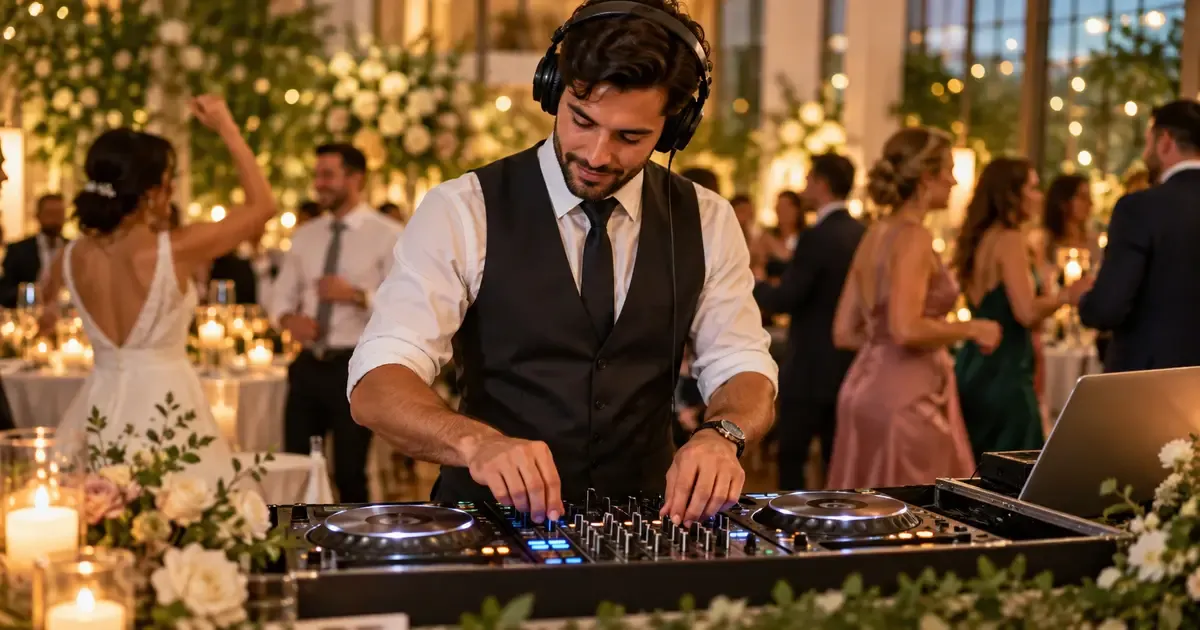
Wedding music selection starts with three decisions: which moments need music, who will provide it, and how much you can spend. Choose the songs for your ceremony and special dances first, then give your DJ or band enough direction to build a reception around your taste and your guests.
Use this guide to create a music brief you can hand to your entertainment provider and wedding coordinator.
How Do You Choose Wedding Music?
Choose wedding music by matching songs to your ceremony and reception, setting a budget, and selecting a DJ, band, or combination. Pick exact recordings for entrances and special dances, then share your preferences and exclusions. Confirm the timing, sound equipment, and backup plan with your provider and coordinator.
- Identify ceremony and reception moments that need music.
- Set a budget using comparable local quotes.
- Choose a DJ, band, or combination.
- Select exact recordings or live arrangements for entrances and special dances.
- Share must-play songs, musical preferences, and do-not-play songs.
- Confirm cues, microphones, and backup plans.
In This Guide
- Set your wedding music budget
- Choose a DJ, live band, or combination
- Plan your ceremony music and cues
- Build your reception music timeline
- Choose songs that fit you and your guests
- Confirm sound, playback, and venue requirements
- Book your entertainment with a clear contract
- Finalize your wedding music checklist
Set Your Wedding Music Budget
How Much Does a Wedding DJ or Band Cost?
The Knot reports average US wedding costs of $1,800 for a DJ and $4,500 for a live band, based on couples married in 2025. These averages are starting points, not quotes. Compare local packages for the same hours, equipment, ceremony coverage, travel, and overtime charges. Source: The Knot’s wedding DJ and band cost report, updated May 2026.
The report draws on a survey of 10,474 US couples. Your location, date, booked hours, and package can all change the price. A reception-only package and one covering the ceremony, cocktail hour, and reception are different purchases, even when both are advertised as wedding entertainment.
Rather than assigning a fixed percentage of your total wedding budget, list everything your music plan requires:
| Budget item | What to clarify in each quote |
|---|---|
| Reception entertainment | Named DJ or band, number of performers, and covered hours |
| Ceremony coverage | Musicians or playback, speakers, and microphones for vows |
| Cocktail hour | Separate performer or additional sound setup |
| Equipment | Speakers, mixer, microphones, lighting, and backup equipment |
| Logistics | Travel, parking, load-in, setup, and teardown charges |
| Additional charges | Overtime rate, requested song arrangements, and applicable taxes |
| Hospitality | Vendor meals, breaks, and any accommodation requirements |
Ask at least a few available providers to quote the same scope. A lower base price may become more expensive once you add a second sound system or ceremony coverage. Check whether gratuity or service charges are already included before setting aside additional money.
For savings elsewhere in your plan, use our wedding budget guide.
Ways to Reduce Music Costs
Prioritize the part of the day where live performance matters most to you. You might book a solo musician for the ceremony and a DJ for the reception, or hire a smaller ensemble instead of a full band.
Ask whether one provider can cover the whole day. Confirm how they will move equipment between spaces. Reduce optional lighting or other add-ons before cutting essential microphones and sound coverage. A shorter performance booking only works if someone is responsible for music and announcements outside those hours.
Choose a DJ, Live Band, or Combination
Is a DJ or Live Band Better for a Wedding?
Choose a wedding DJ if you want specific original recordings and a broad mix of genres. Choose a live band if live vocals and instruments are a priority. Compare repertoire, space, emcee services, break coverage, and total cost before booking; either option can suit a lively reception.
Neither choice guarantees a full dance floor. The provider’s skills, repertoire, and ability to respond to the room matter.
| Decision | Wedding DJ | Live wedding band |
|---|---|---|
| Song versions | Can play the requested recording if available through their music sources | Performs its own arrangement; ask to hear examples |
| Musical range | Often broad, but confirm cultural and niche selections | Depends on the band’s repertoire and lineup |
| Special requests | Confirm availability and clean versions | Ask about learning fees and deadlines |
| Space and setup | Ask for booth, speaker, and power requirements | Ask for stage footprint, power, and sound requirements |
| Break coverage | Confirm continuous coverage and any assistant arrangements | Agree on recorded music or another performer during breaks |
| Announcements | Many DJs offer emcee services; confirm the style | Some bands provide an emcee; confirm who handles it |
Watch full performance clips with audible sound, rather than choosing from a promotional montage alone. Ask who will actually perform at your wedding and whether the lineup in the video matches the booking.
A DJ with a live saxophonist or percussionist can be another option. Confirm who coordinates the performance, whether they have worked together, and what happens when the live musician finishes.
Plan Your Ceremony Music and Cues
Ceremony music needs a clear start and stop plan. Choose the exact song or arrangement, identify the person giving the cue, and tell the performer how to handle a longer or shorter entrance.
Before selecting songs, ask your officiant and venue about restrictions. A house of worship may require approved music, its own musicians, or permission for outside performers. Coordinate the music with any readings, rituals, and cultural traditions in your ceremony plan.
How Many Songs Do You Need for a Wedding Ceremony?
The number of wedding ceremony songs depends on your entrance order and ceremony plan. Choose music for guest arrival, the processional, and the recessional, then add separate selections for family seating, a couple’s entrance, or rituals if needed. Confirm durations and cues with your officiant and music provider.
A Ceremony Music Cue Sheet
The following is a sample structure; include only the moments your ceremony uses.
| Moment | Musical purpose | Cue to agree on |
|---|---|---|
| Prelude | Background music while guests find seats | Begin at the agreed guest arrival time |
| Family seating | Optional transition for parents or other honored guests | Coordinator signals that seating is starting |
| Wedding party processional | Sets the walking pace | First person is ready to enter |
| Couple’s entrance | Marks the entrance of one or both partners | Coordinator confirms the aisle is clear |
| Ritual or signing | Optional music during a planned pause | Officiant signals the start and end |
| Recessional | Celebrates the end of the ceremony | Agreed words or signal after the pronouncement |
| Postlude | Continues while guests leave | End when the ceremony space has cleared |
For each song, record the title, artist or composer, exact version, starting timestamp, and ending instruction. Avoid vague notes such as “play the chorus.” Different recordings may reach the chorus at different times.
Match the Song to the Walk
Walk the aisle at your expected pace during the rehearsal. If your favorite recording has a long introduction, agree on a starting timestamp. If the wedding party takes longer than expected, ask whether the musician can repeat a passage or the operator can continue the track naturally.
An instrumental version can work well when you like a melody but the lyrics distract from the ceremony. For live musicians, confirm that your chosen arrangement fits their instruments. Make sure music ends before spoken vows unless you have deliberately agreed otherwise.
Build Your Reception Music Timeline
Give your DJ or band the same schedule your coordinator, caterer, and photographer use. Music changes should follow real cues, especially when dinner service or speeches run late. Our wedding day timeline guide can help you place these moments in the wider schedule.
| Reception moment | Music direction | Detail to communicate |
|---|---|---|
| Cocktail hour | Background music that allows conversation | Preferred genres and whether guests can make requests |
| Grand entrance | A short, upbeat selection if you want an entrance | Names, pronunciation, order, and starting timestamp |
| Dinner | Lower-volume selections | Speaker placement and room volume |
| Toasts | Pause music for speakers | Who introduces each person and who supplies the microphone |
| First dance | One meaningful song or edited selection | Exact recording, duration, and ending cue |
| Family dances | Optional songs for chosen loved ones | Participants, order, and whether guests join midway |
| Open dancing | A flexible mix based on your preferences | Must-play songs, do-not-play list, and request policy |
| Final song | A shared send-off or private final dance | Whether guests stay in the room and who announces the ending |
You do not need every traditional event. Skip parent dances, bouquet tosses, or staged entrances if they do not fit your celebration. Tell your emcee explicitly so they do not announce an unwanted activity.
For a band, place breaks where they create the least disruption and specify who provides music during them. Confirm whether the band can adjust its sets if the meal or speeches take longer than planned.
Choose Songs That Fit You and Your Guests
Build three short lists: must-play songs, musical preferences, and do-not-play songs. Keep the must-play list focused so your provider has room to respond to the dance floor.
Your preference list can describe the atmosphere more effectively than a long queue of tracks: “Motown and soul during dinner; pop, Latin music, and 2000s throwbacks for dancing” gives useful direction. Identify specific cultural songs or dances and explain when they belong in the celebration.
First Dance and Family Dance Ideas
Choose a song whose lyrics and pace feel comfortable to you. Listen to the whole track, try dancing to it, and check the exact recording before making it final.
Possible first dance starting points include:
- “Can’t Help Falling in Love” — Elvis Presley
- “All of Me” — John Legend
- “Perfect” — Ed Sheeran
Possible family dance starting points include:
- “My Wish” — Rascal Flatts
- “What a Wonderful World” — Louis Armstrong
- “Isn’t She Lovely” — Stevie Wonder
These are examples to audition, not a required playlist. Read the lyrics in the context of your relationship, and consider an instrumental alternative when the melody fits better than the words. If a track feels too long, ask your DJ about an agreed edit or your band about a shorter arrangement.
Make the Dance Floor Welcoming
Include music that reflects your guests as well as your own favorites. Share a few songs that different groups recognize instead of assigning rigid percentages to genres or age groups. Ask your provider to move between styles in coherent sets and adjust when the room’s energy changes.
Decide whether you want clean versions, line dances, audience participation, and guest requests. Explain any sensitive song exclusions privately. A request should not override your do-not-play list.
You can collect song ideas through your RSVP form or a shared playlist. Treat those suggestions as input for your provider, and review them before the wedding.
Confirm Sound, Playback, and Venue Requirements
Good song choices still need a reliable sound plan. Have your provider speak directly with the venue about power, load-in access, setup time, sound limits, and the music cutoff. Ask how outdoor equipment will be protected and where it will move if weather changes.
Confirm microphone coverage for vows, readings, and toasts. A musician’s amplification does not automatically include an officiant microphone. Ask your videographer and sound provider to coordinate any audio feed needed to record the ceremony or speeches.
Can You Use Spotify for Wedding Music?
Spotify can help you discover songs and share planning ideas, but a personal subscription should not be treated as authorization for event playback. Spotify’s policy limits the service to personal, non-commercial use and prohibits public playback from a business.
Ask your DJ, musicians, and venue to confirm the music sources and permissions appropriate to your event. Music permissions depend on the event and how the songs are used. Ask the venue and provider who handles any required licenses. Ask your videographer separately about music included in an edited wedding film or online highlight video.
If You Plan to Handle Playback Yourself
A DIY setup needs an assigned operator who can stop music for vows, switch tracks, manage microphones, and troubleshoot. That person should be able to stay at the controls during key moments.
Use a music source permitted for your event. Test the speakers at the venue and arrange an offline backup if your music source allows it. Turn off notifications, shuffle, autoplay, and any other settings that could change your song order. Keep power supplies, cables, adapters, and a backup device accessible.
Separate ceremony, cocktail hour, dinner, and dancing into clearly labeled sets. Rehearse the ceremony cues and test the backup before guests arrive. For a large event or several separate spaces, compare the full equipment and staffing cost with a professional quote before choosing DIY.
Book Your Entertainment With a Clear Contract
Ask these questions before paying a deposit:
- Who will perform, and what happens if that person or a band member becomes unavailable?
- Which locations and hours are covered, including ceremony and cocktail hour?
- Who acts as emcee, and can we agree on announcement wording and pronunciation?
- Which microphones, speakers, and backup equipment are included?
- Can you provide our cultural selections and requested song versions?
- When are the final song list and timeline due?
- How are breaks, guest requests, and do-not-play songs handled?
- What are the overtime rate, payment schedule, and cancellation or rescheduling terms?
- Can you meet the venue’s insurance, power, space, and sound requirements?
Put the covered hours, equipment, and charges in writing. For a band, name the performers, explain how replacements are handled, and list any songs it has agreed to learn. If the ceremony and reception are in different locations, ask whether your DJ needs an assistant or a second sound system.
Our wedding vendor negotiation guide can help you compare scope and discuss changes to a package.
Finalize Your Wedding Music Checklist
Work backward from your provider’s submission deadline. Send one final version of your music brief to the provider and coordinator, with a clear date so earlier drafts do not cause confusion.
- Confirm the covered hours, locations, performer, and final balance.
- List ceremony songs with exact versions, timestamps, and cue instructions.
- Identify the coordinator or designated person who gives each cue.
- Confirm entrance names, pronunciation, special dances, and omitted traditions.
- Share must-play songs, preferences, do-not-play songs, and the request policy.
- Agree on clean versions, announcements, and band break coverage.
- Confirm microphones, power, sound limits, weather arrangements, and backups.
- Share the final timeline and day-of contact details.
A useful brief is specific about the moments that matter to you and flexible about the rest. Once your provider knows your songs, boundaries, and cues, you can spend the celebration listening, dancing, and enjoying your guests.

Bridal by Bentley
Wedding Editorial
Bridal by Bentley publishes wedding inspiration and practical planning guides to help couples compare options and prepare for their celebrations.